
Are Downpipes Worth It? Real Dyno Numbers & Honest Verdict
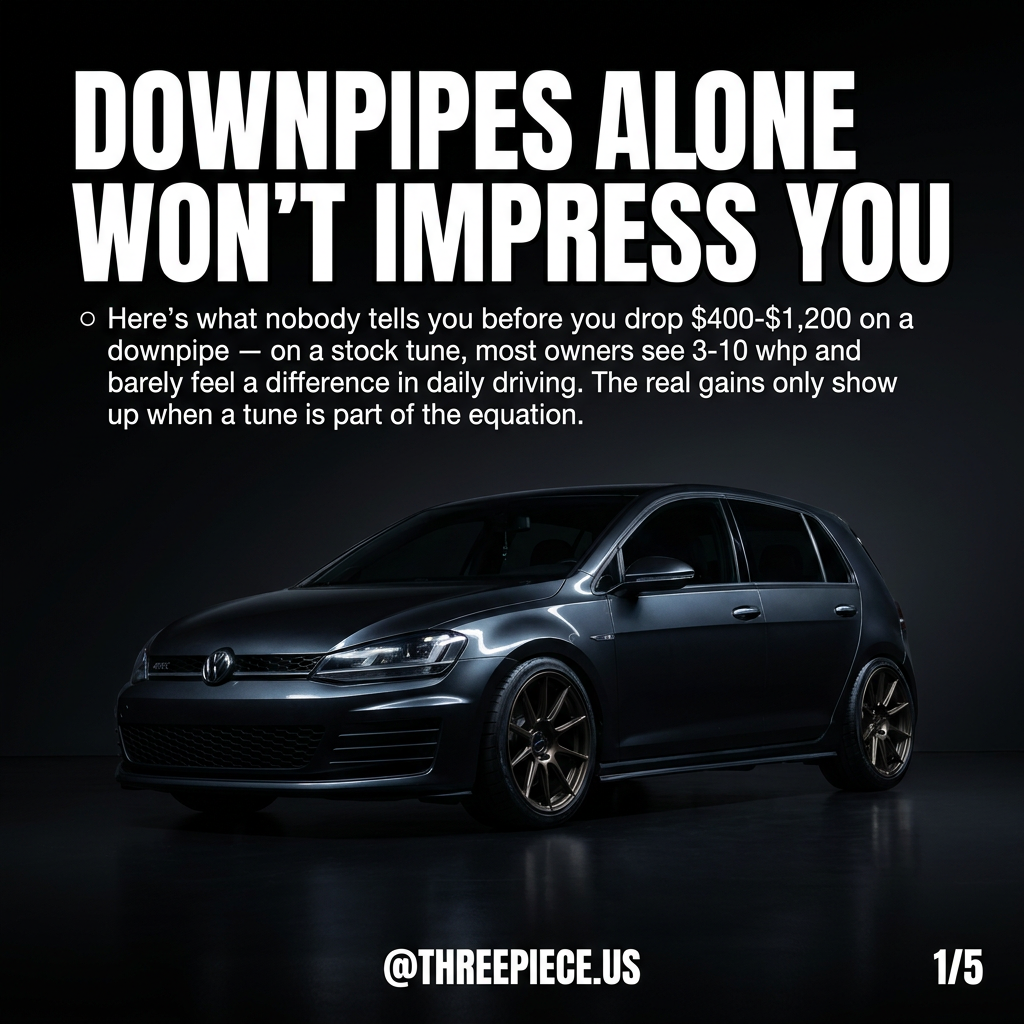
Are downpipes worth it? The short answer is: not alone. Across every turbocharged platform — from the N54 335i to the Evo X to the 10th-gen Civic Si — forum owners and tuners report the same thing. A downpipe on a stock tune delivers 3–10 whp at best. The real gains only unlock when you pair the hardware with a proper ECU calibration. This is the mod that separates informed builders from parts-counter impulse buyers.
Quick links
- Your stock ECU is the bottleneck
- Real dyno numbers across platforms
- What you're actually paying for
- Catless vs. catted — the inspection headache
- Cheap downpipe failure modes
- Verdict: worth it — with conditions
Your Stock ECU Is the Bottleneck
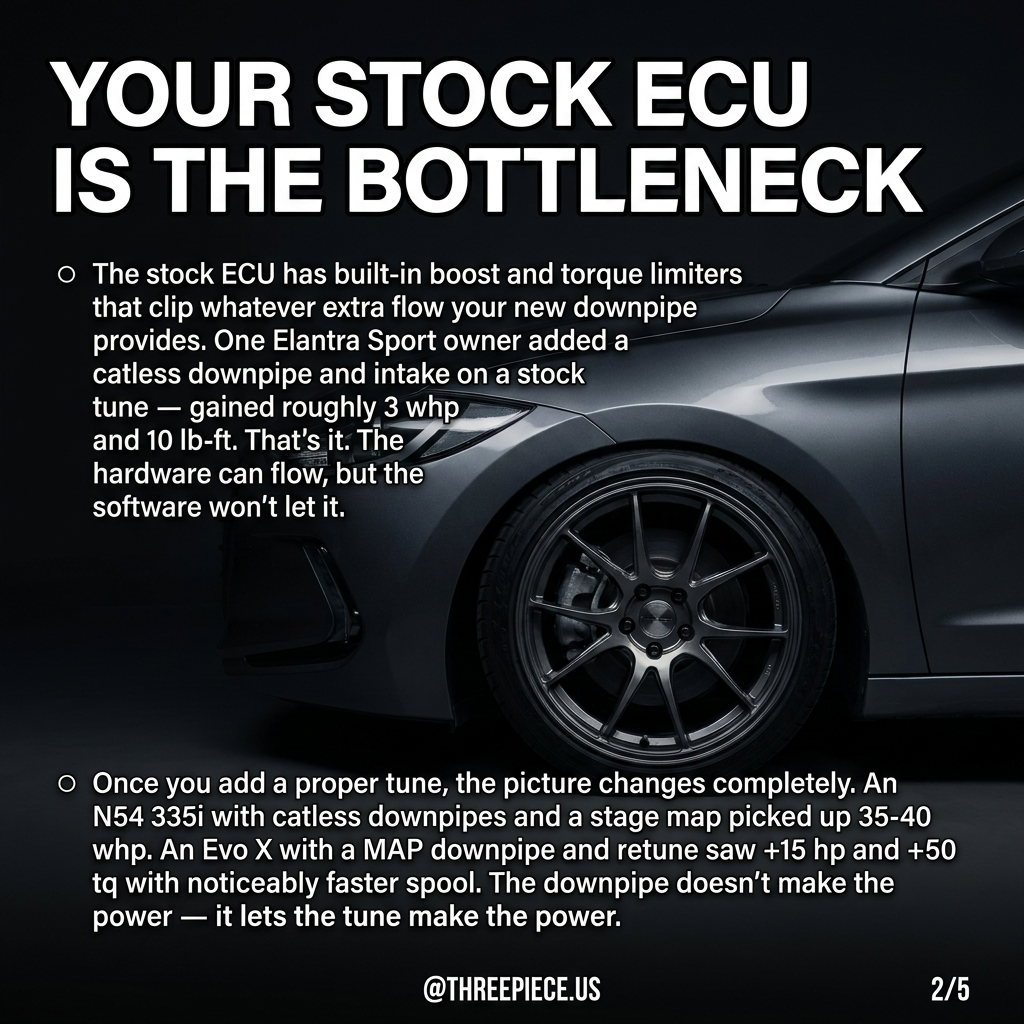
Every modern turbocharged car runs factory boost and torque limiters baked into the ECU. When you bolt on a less-restrictive downpipe, the exhaust side of the turbo can evacuate gases faster — in theory, that means quicker spool and more available boost. In practice, the stock software sees the change and compensates by pulling timing or capping boost pressure. The hardware can flow, but the software won't let it.
One Hyundai Elantra Sport owner documented this perfectly: catless downpipe plus intake on a bone-stock tune yielded roughly 3 whp and 10 lb-ft. That's a rounding error on most dynos. The same combination on a platform like the N54 335i with a stage map? 35–40 whp. An Evo X with a MAP downpipe and a proper retune picked up +15 hp and +50 tq with noticeably faster spool. The downpipe doesn't make the power — it lets the tune make the power. If you're curious about how air-fuel ratio interacts with these tuning changes, our breakdown of how AFR works and why it matters covers the fundamentals.
Real Dyno Numbers Across Platforms
The internet is full of inflated claims. Here's what actual dyno sheets and forum-verified data show when you combine a downpipe with a tune on a stock turbo:
- Mitsubishi Evo X — O2-eliminator downpipe with COBB AccessPort tune and full bolt-ons: +17.4 whp, +30 wtq (tested at 5,600 ft elevation, so sea-level gains are likely higher).
- Mazda 3 Turbo — CorkSport catted downpipe, short-ram intake, turbo inlet pipe, 80mm cat-back, stock tune: +18 whp, +24 wtq at ~4,000 RPM. With a full custom DISI tune, the car made 269 whp and 356 wtq.
- Subaru WRX — 3" catless downpipe with a conservative "happy tune": roughly +30 whp on a Mustang dyno.
- BMW 340i (B58/F30) — catless downpipe with MPPSK flash: reported gains ranged from +10 to +52 whp, with most experienced tuners estimating the real peak closer to +20 whp.
Notice the pattern: the downpipe alone is marginal. The downpipe plus tune is where the car transforms. If you're building an N54 or B58 BMW, our CT4-V Blackwing vs BMW M3 comparison covers how these platforms stack up once you start modding. For the Giulia Quadrifoglio crowd chasing similar gains, our Giulia QF bolt-on build guide documents a path to 550 whp using the same downpipe-plus-tune philosophy.

What You're Actually Paying For
A quality catted downpipe runs $400–$1,200 for the part. Add $200–$400 for a tune and potentially several hours of shop labor — some owners report total install quotes north of $1,000 depending on the platform. Budget $800–$2,000 all-in for a properly done setup with a tune included.
The gains you're buying aren't just peak horsepower. Owners consistently report faster turbo spool, stronger midrange torque, and better throttle response — the car wakes up between 3,000 and 5,000 RPM where you actually drive it. That's the part the dyno sheet undersells. A stock downpipe on a car like the Camaro LTG drops from 3.00" to 2.25" through the catalytic converter — that restriction chokes the turbo at the exact RPM range where you want it responding. Aftermarket pieces maintain full diameter through the entire pipe.
If you're shopping for a specific platform, the Invidia Catted 70mm Downpipe for the 2016+ Civic 1.5T at $1,044 is one of the most proven catted options for the 10th-gen platform. For FK8 Type R owners, the Skunk2 Civic Type R Downpipe Kit with Cat at $825 is a popular choice with excellent fitment. Budget builders on the same chassis can look at the Skunk2 Civic 1.5T Downpipe Kit with Cat at $768. On the other end of the spectrum, the Akrapovic G80 M3/G82 M4 Downpipe with Catalytic Converter at $4,348 represents the absolute top tier — full stainless construction, OEM-level fitment, and a brand trusted at the highest levels of motorsport.
For a broader look at forced-induction mod strategy, our supercharger kits guide walks through the same cost-vs-gain math on the naturally aspirated side.
Catless vs. Catted — The Inspection Headache
Catless gives you maybe 5–10 whp over a high-flow catted pipe. That's it. In exchange, you get a check engine light, a sulfur smell that seeps into the cabin, and an automatic emissions failure in any regulated state. Some owners report the smell alone makes catless setups miserable on highway drives — especially in warmer climates where heat soak pushes exhaust gases into the cabin through the firewall.
Cheap catless pipes make everything worse. Thin steel, poor welds, and inconsistent fitment lead to exhaust leaks within months. One forum-documented build needed an extra $250 in repair work for leaks immediately after install. That's money you could've spent on a proper catted unit in the first place.
A catted, resonated downpipe is the move for most people. You keep emissions compliance, cut the drone and rasp that make catless setups unbearable on the highway, and still get the flow improvement that matters once you're tuned. The Stainless Works F-150 3.5L EcoBoost 3" Downpipe with High-Flow Cats at $1,527 is a perfect example — full 3" diameter maintained through the cats, factory connection points, and zero CEL headaches. The truck community has been on this for years while sport-compact guys were still arguing about catless on Reddit.

Cheap Downpipe Failure Modes
Not all downpipes are created equal, and the budget options are where most builds go sideways. Here's what actually goes wrong:
- Exhaust leaks at the flange: Poor-quality castings and thin gasket surfaces create leaks at the turbo-to-downpipe connection. This is the most common complaint on budget units.
- Weld cracking from heat cycling: Cheap stainless or mild steel pipes that aren't properly back-purged during welding develop micro-cracks within the first year. Heat cycling accelerates this — the pipe expands and contracts thousands of times.
- Flex section failure: Some downpipes include a flex joint to absorb engine movement. Budget flex sections use thin bellows that tear, creating a massive exhaust leak under the car.
- O2 sensor bung placement: Poorly positioned sensor bungs give bad readings to the ECU, causing fueling issues even with a tune. This is especially problematic on catted units where the post-cat sensor needs to see specific exhaust conditions.
This is why spending the extra $200–$400 on a reputable brand matters. If you approach your build with the same attention to detail as your wheel setup, you won't regret it. Speaking of builds, our oil catch can guide covers another supporting mod that matters more than most people realize on turbocharged platforms.
Verdict: Worth It — With Conditions
If you're planning a tune and at least basic bolt-ons, a quality catted downpipe is absolutely worth it. It's the piece that unlocks everything upstream of the turbo and lets the ECU calibration actually use the available flow. The $800–$2,000 all-in cost delivers faster spool, stronger midrange, and a more responsive car in the RPM range where you actually drive.
If you're staying on a stock tune and just want more sound, spend that money on a cat-back first and save the downpipe for when you're ready to go stage two. The downpipe is the best mod you'll never feel without the tune to match it.
Once you've sorted the exhaust side, the next step is making sure the rest of the build keeps up. Browse our vehicle gallery for inspiration on how other owners are finishing their turbo builds — from Work Wheels to suspension upgrades. And if you're running a VW or Audi platform, the aFe GTI Turbocharger Inlet Pipe at $210 pairs perfectly with a downpipe and tune for a complete intake-to-exhaust flow path.
